My japanese name is 黒田 Kuroda (black field) 久美子 Kumiko (eternal beautiful child).
Take your real japanese name generator! today!
Created with Rum and Monkey's Name Generator Generator.
` timed out-- 4/26/2007 10:30:00 pm
So, my uncle's been raving about this restaurant at Katong (near his place ma). I've driven past it on many occassions and there's ALWAYS (kid you not) a queue of at least 4 tables. Now that they're renovating + expanding the place, hopefully the wait will not be too long.
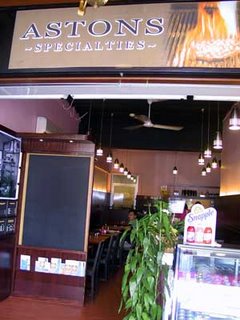
So here's what the menu's like....
Gourmet Sausages at Astons!
We are now serving sausages from "Butcher House"
The Round $9.50 is a XL snail with 2 sides
The Sampler $12.50 gives you a selection of 4 different sausages
As always, Astons gives you Quality and Value!
(Anyone a huge sausage fan?? I'm ok lar...)

Grilled US Prime Ribeye Steak............ Oh my f'kin god!!! The meat is airflown direct from Harris Ranch in the US
USDA Prime meat is beefy and robust but still very tender due
to the excellent marbling of the meat
For a limited time only, it is $29.90 with 2 side dishes
So... looks like they don't have a fixed menu... hmm.

NZ Ribeye Xtra Cut - $14.90. Oooohhh.. I like it juicier! Talk so much.. cannot eat also... sob sob.

Fish & Chips - $5.90. Pretty reasonably priced don't you think?? It's probably one of the few things I can try at Aston with my freaking braces still attached to my not-so-soon to be perfect teeth.

Crispy Chicken - $5.50. I want, I want....

Grilled Fish - $5.90. Another one of the dishes I can eat with braces... hmm.

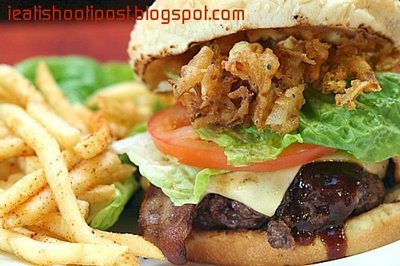
ieatSuperburger - $12.50. The ieatSuper Burger is made from 200gm chopped Sirloin Steak, 2 slices of cheese, 2 rashers of bacon, Romaine lettuce, tomatoes, Astons Special Hickory Smoked BBQ Sauce, Astons Special Sauce and crispy onion frost all piled up in a sesame seed bun.
Sounds pretty tempting... don't think I'll venture into that just yet... another 19 months... definitely on the list of food to eat when metal's off..
Wagyu (和牛) Ribeye - $38.90. For those who've had proper wagyu, you'll remember how that piece of meat just melted into nothingness... But yeah I wouldn't pay that much for it either...
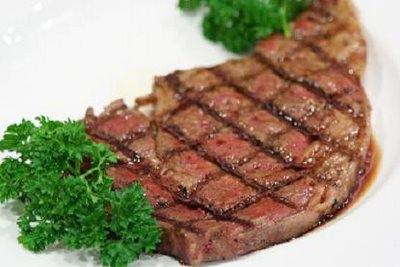
Conclusion? I wanna try Astons out.................................................................................... man.. lunch time now.. am so hungry typing this entry up.
p.s.: I heard they have an outlet at Chomp Chomp... people say not nice... ok that's all.
p.p.s: I have a feeling it's not the same Astons.... okok.. really that's all.
` timed out-- 4/23/2007 11:31:00 am
I'm gonna have this for dinner!!!

That's of course unless somethine else catches my fancy tonight... hehehe Haven't had a good meal in what seem to be ages!! Looking forwards to dinner already! (and it's only barely 9.30)
*snore*
` timed out-- 4/23/2007 09:21:00 am
the braces that is.... I'm all scratched up inside my mouth... only 19 months more to go...
persevere!
1.23pm (after lunch) - I feel disabled....
` timed out-- 4/19/2007 10:44:00 am
我有会为我不幸遭遇而流泪的朋友吗?
反过来说,
我有为了遭遇不幸的朋友而流过泪吗?
` timed out-- 4/16/2007 12:48:00 pm
| You Should Learn Spanish |

For you, learning a language is about career advancement and communication.
Knowing Spanish will bring you tons of possiblities for jobs and travel. Bárbaro! |
` timed out-- 4/12/2007 08:52:00 am
I took a day off work cos I'm getting:
*TADA*

Yes... I'm getting braces... after many years of procrastination. The metal braces will cost $3800. Ceramics will cost about $4300. I think with that kind of price difference, I will just get the metal braces and a wii console with that extra $500 I saved!!!

Surprisingly, I need not extract my molars for the braces cos apparently there'll be too much gap if I did. So the orthodentist suggested that I had contouring (filing my teeth down by 1mm.. sounds painful) done 8 months from now to create sufficient space (3mm on lower jaw and 5mm on upper jaw.) If you do the maths, that makes 8 teeth that needs filing... oh man. The good news is, my teeth aren't as bad as I thought it was... it'll take 19 months of braces (that's less than 2 years.... most pple wear it for 2 years.. at least) and then followed by months of retainer... but all looks good. I'm looking forward to whitening my teeth of cos... =)
Right now, I have separators fitted in between my molars and premolars to create a gap for fitting the bracket next week or the week after. This is what it looks like...

On a totally irrelevent note, it feels soooooooooooooooooooo good not having to wake up early to go work. I shall wake up at 7.30 tomorrow, leave at 8, reach by 9. Perfect!
` timed out-- 4/12/2007 12:32:00 am
Just wanted to share with you guys how rediculous my dad is at times. 2 days ago, (this happened in broad day light when I was still asleep in bed) my dad decided to take without permission (
steal) some of my alcohol. He was rather fascinated by the spread of liquor I had collected over the year. So he mixed himself a cocktail... or at least he thinks it's a cocktail.
Recipe:
1 part vodka
1 part lychee liquor
1 part pimms
1 part martini rosso
1 part baileys
and top it all off with FLAT coke.
Gross! When I woke up, he let me try a sip...... it was vile... Mona, if you thought the white wine you had was vile, wait till you try this. It's kinda like cough syrup gone bad... Can't believe I got conned into trying..... *pui*!
` timed out-- 4/09/2007 09:42:00 am
第二型助人型
二号特性:帮助者
基本恐惧:不被爱,不被需要
基本欲望:感受爱的存在
对生命的要求:如果有人爱我及有人被我爱护,我就 OKAY 了。
特质:感性,热心,友善,取悦人,时常感觉自己付出得不够,乐于助人,甘于牺牲,占有欲强,有 ( 感情帐簿 ) 。
顺境 ( 可以爱人及被爱时 ) :富于同情心,体恤别人的处境,付出无条件的爱。
逆境 ( 没有爱或被背叛时 ) :横蛮无理,操纵性强,对人有过分的要求。
处理感情的方法:过分强调别人的需求,而忽略了自己的需求。否认:本身的需求,对生命的失望,愤怒感,被伤害的感觉。
身体语言:柔软而有力,愿意与人有身体接触;面部表情;柔和,多笑容;讲话方式 / 语调:速度倾快,声线较深,自嘲,有幽默感。
常由词汇:你坐着,让我来;不要紧,没问题;好,可以;你觉得呢 ?
工作环境:强调合作性,大家同向一个目标迈进,没有人际纠纷。
不能处理逆境时出现的特征;戏剧型性格:
骄傲:对爱的极度需求;享乐主义;具高度诱惑性;任性;戏剧化 ( 吸引注意 ) ;不要求 / 不容许别人帮助;感情易受牵制;反智主义。
二号警钟:取悦人;表现过分友善;太关怀别人的处境;太过慷慨;过分阿谀奉承;填补内心的空虚;不能确定别人的好感是否真的;不懂得接受别人的赞誉。
座右铭: 施比受更有福
典型冲突点: 偏袒某些同事,引起其它人的不满,小圈子
优点: 令人觉得特别 / 被欣赏
缺点: 听话就有好日子过,否则不管你
最适应工作环境: 很多人际沟通,被重视,被爱戴
不适应工作环境: 缺乏正面的人际沟通
管理方式: 感性,助人成长,全都往肩上扛
令人不安地方:2 号的爱有时令人窒息;缺乏客观评估标准;爱人变成害人
沟通要点: 保护人性化;清楚二号的盼望;帮助二号讲出本身的真正需求;不要让二号为你付出太多;小心二号将你的批评当作人身攻击;恰当时有一定的身体接触
激发要点: 让二号感觉伟大;在可能的范围内,尽量暖二号的心;注重一对一的沟通;帮助二号提升自我价值;二号害怕当众出丑,容许二号有足够的时间及资料去学习新事物 ; 二号害怕冲突;向二号确保冲突不会影响别人对他的好感;
时间管理: 时间不属于自己的;解救方案;防止二号越帮越忙,令他们分辩出他们想付出的未必是别人需要的;二号不容忍人际空间,提醒二号有时要袖手旁观,给予别人成长机会;鼓励二号先作好自己的工作;提点二号不要将人家的问题扛在肩上;
达成协议: 二号要面子,令二号有下台阶
常见问题: 扮演牺牲者,事事个人化
解救方法: 不要容许 2 号承担太多的责任;将事与人分清楚;
` timed out-- 4/09/2007 09:41:00 am

Venice

Pisa - Campo dei Miracoli: Leaning Tower

Naples - Bay of Naples and Mt. Vesuvius

Florence

Rome - The Colosseum / Coliseum
` timed out-- 4/05/2007 09:12:00 am
Greece
Climate:
Despite its small size, Greece has a varied climate.
Most of the country, including all coastal areas, enjoys a so-called Mediterranean climate, almost identical to much of California. Summers are hot and dry with a 7-month period of near-constant sunshine generally from April until November. The remainder of the year is characterized by a relatively cold, rainy period which generally starts sometime in November and lasts until late March or early April. Sporadic rains do occur during the dry season, but they tend to be rare, quick showers. The country’s Ionian Coast and Ionian Islands tend to receive more annual precipitation than the rest of the country. The islands in the southern Aegean and parts of the southeastern mainland are the driest areas of the country.
The most pleasant weather occurs in May-June and September-October. The warmest time of the year starts in mid-July and generally lasts until mid-August, when the annual meltémi winds from the north cool the country. Mid-July to mid-August is the height of summer, and the midday sun tends to get very strong; during this time, most Greeks avoid heavy physical activity outdoors between 1:00 and 5:00 PM. It is best advised to get in tune with the local way of life by waking up early, doing all sightseeing and errands in the cool morning hours, and then spending the afternoon in the relaxing shade or at the beach. In fact, the bulk of tourists arrive in Greece during the height of summer, to do just that!
Summer evenings tend to be very rewarding. As strong as the sun may get on a summer afternoon, the low levels of atmospheric humidity in most areas of the country prevent the air from trapping much heat, and temperatures tend to dip to very pleasant levels in the evenings. But even during midday, high temperatures actually tend to be quite comfortable as long as the time is not spent doing a lot of walking or other physical activity. (Athens, however, can still be uncomfortably warm during summer afternoons due to the predominance of concrete in the city, an effect similar to New York City.) Coastal areas near open waters (away from tightly-closed bays and gulfs) especially on many of the islands, tend to be quite breezy, and can be quite cold at night.
While the Mediterranean climate characterizes most of the country, there are two other climate systems that are present. One is the cool Alpine climate which is found on mountainous areas of the country's interior, including many high-altitude valleys. Another system is the Continental climate found on the interiors of north-central and northeastern Greece, and gives those areas very cold winters and warm, relatively humid summers.
Cities:
Cyprus

Climate: Temperate; Mediterranean with hot, dry summers and cool winters
Terrain: Central plain with mountains to north and south; scattered but significant plains along southern coast.
Districts: Cyprus is divided into 6 administrative regions. Each district carries the name of its administrative capital. Following the Turkish Invasion in 1974, and the division of the island, the republic of Cyprus has no effective control over the whole of the Kyrenia and parts of the Famagusta districts.
Famagusta district (South) /
Famagusta district (North)Kyrenia districtLarnaca districtLimassol districtNicosia district (South) /
Nicosia district (North)Paphos districtCities: Note that Cypriot cities have a variety of historical spellings and writings, all in fairly common use, and which change according to the context, whether it be Greek Cypriot, Turkish or English tourist... The following list emphasises traditional English spellings, that will most often be encountered by the traveller.
Nicosia (also Nikosia, Lefkosia)
Larnaca Larnaka
Limassol Lemesos
Paphos Pafos
Things to buy:
Cypriot wine - the iconic local variety known as Commandaria is strong, sweet and somewhat akin to port wine
Lacework of an intricate nature - from the village of
Lefkara.
Zivania - is a strong spirit based alcoholic drink
Things to eat:
Cypriot food bears a distinct resemblance to Greek cooking, and uses lemons and olives extensively.
Cypriot meze (appetizers akin to Spanish tapas) are an art form, and some restaurant serve nothing but.
Halloumi (Χαλλουμι) is a uniquely Cypriot cheese, made from a mix of cow's and sheep's milk. Hard and salty when raw, it mellows and softens when cooked and is hence often served grilled.
For more info you can also visit Cyprus' most comprehensive eating out guide that features Cyprus restaurants
CyprusEatOutEgypt
Climate: Egypt is largely desert, an extension of the great Sahara Desert that bands North Africa. Save for the thin strip of watered land along the river Nile, very little could survive here. As the ancient Greek philosopher Herodotus stated: "Egypt is the gift of the Nile".
Generally, dry and very hot summers with moderate winters - November through to March are definitely the most comfortable months for travel in Egypt. There is almost no rain in the Nile valley, so you won't be needing wet weather gear!
Cities:
Holidays:
Banks, shops and businesses will close for the following Egyptian National Holidays (civil, secular). Public transport may run only limited services:
7th January (Eastern Orthothox Christmas)
25th April (Liberation Day)
1st May (Labour Day)
23rd July (Revolution Day)
6th October (Armed Forces Day)
Vietnam
Climate: Vietnam is large enough to have several distinct climate zones.
The
South is hot, humid and tropical, with temperatures hovering in the 25-30°C all year round, but it rains the most from May to November.
The
North has four distinct seasons, with a comparatively chilly winter (temperatures can dip below 15°C in Hanoi), a hot and dry summer and pleasant spring (March-April) and autumn (October-December) seasons. However, in the
Highlands both extremes are amplified, with occasional snow in the winter and temperatures hitting 40°C in the summer.
In the
Central regions the weather is somewhere in between, only just to confuse things here the rainy season is in the summer, not the winter.
Cities:
Nepal
Climate:
Nepal has a Monsoonal climate with four main seasons - though traditionally a year was categorized into six distinct climate periods: Basanta (spring), Grishma (early summer), Barkha (summer monsoon), Sharad (early autumn), Hemanta (late autumn) and Shishir (winter).
Below is a general guide to conditions at different seasons:
Heavy monsoonal rains from June to September - the rains are generally lighter high in the Himalayas than in Kathmandu, though the moutain peaks are often lost in cloud.
Clear and cool weather from October to December - after the monsoon, there is little dust in the air so this is the best season to 'experience' the mountains.
Very cold from January to March, with the temperature in Kathmandu often dropping as low as 0°C at night. It is possible to trek in places like the
Everest region during the winter, but it is extremely cold and snow fall may prevent going above 4,000 - 4,500 meters.
Dry and warm weather from April to June - there is an abundance of blooming flowers in the Himalayas at this time, with rhododendrons, in particular, adding a splash of color to the landscape.
Cities:
Kathmandu — capital and cultural center of Nepal
Bhaktapur — well-preserved historical city, center of Nepali pottery making.
Biratnagar — this city is in eastern Nepal near Dharan and famous for political reason.
Birgunj — business gateway between India and Nepal. It is in the mid-southern Nepal
Dharan — lovely city in eastern Nepal
Namche Bazaar — a Sherpa settlement located in the
Solo Khumbu region - popular with trekkers
Patan — sister-city of Kathmandu and metal working center
Pokhara — picturesque lakeshore town and base for many of Nepal's most accessible treks
Things to do:
Rafting - Overnight trips for all levels of experience leave from
Kathmandu and
Pokhara. The Kaligandaki is a popular river.
Jungle Safari -
Royal Chitwan National Park offers elephant rides, jungle canoeing, nature walks, and birding, as well as more adventurous tiger and rhino-viewing.
Parties - "The Last Resort", near the Tibetan border, has frequent Full Moon Trance Parties, lasting 2-3 days. Watch for posters and check music shops.
Pokhara has started featuring its own brand of Full Moon raves and interesting Western takes on Nepali festivals.
Massage - "The Healing Hands Center", in Kathmandu, has monthly five-day, ten-day and one-month Ancient Massage courses.
Trekking - Most of the trekking Nepal is called "Tea-House Trekking" as the day's hike is between guesthouse-filled towns. While this doesn't make the treks that much easier, it means there is no need for tents, food, water, or beer-- all those things, plus luxuries such as apple-pie, can be purchased along the way. Remote trekking is also possible, but unless you are an experienced wilderness trekker, it is recommended to hire a guide and porters. See also "Stay Safe" for information about Maoists rebels in remote areas.
Everest Base Camp Trek: Stunning scenery, Wonderful people. See 'Regions' -
KhumbuAnnapurna Circuit: A 3-4 week trek around the Annapurna mountains.
Jonsom-Muktinath Trek: The last week of the Annapurna Circuit, done in the opposite direction. Known as the "Apple-Pie Trek" partly for crossing the apple growing region of Nepal, and partly for being one of the easier (but far from "easy") treks.
Helambu Langtang Trek: Relatively easy Trek from Kathmandu
Mera Peak Climbing: Enjoy panoramic views of Mt. Everest (8848m), Cho-Oyu (8201m), Lhotse (8516m), Makalu (8463m), Kangchenjunga (8586m), Nuptse (7855m), Chamlang (7319m).
Island Peak Trek: The Island Peak trek in the
Everest region takes in some of the most spectacular scenery in the Himalayas.
Some tips for trekking in Nepal include:
Despite all the adverts on the sides of tea-houses, hot showers generally do not exist (except in Namche Bazaar and the lower
Everest region). You can certainly get a bucket of hot water on request in most places, which is good enough. Solar showers only work when there has been a enough sun light (so they don't work at night - and they are never that hot anyway).
A pack of cards is great for the long evenings. Taking a cheap CD/MPEG player is also an option. Alternatively, unless you're trekking in a very unpopular season (such as monsoon), you will usually meet fellow trekkers on the trail, often spending many nights in the same lodges together, so be open to conversation and you may make friends from around the world.
When it gets dark, have a candle handy - especially post monsoon when a lot of the electricity lines are down (most lodges can supply, but always good to have one just in case).
A "finger" or "sawn-off" toothbrush is much more compact and easy to use in the dark, and a pack of "Wet Wipes" to clean yourself with in the morning and every second day is very handy, as is antiseptic hand spray or gell to use before food and after toilet.
Take along some safety pins (to fix bust zips/flaps/etc.) and also some cheap/small clothes pegs with a bit of washing line and "camp" wash (during the trek, you will need to do some washing, which of course will need drying). Don't screw tops down too tight - or at least open every day any sealed tubes/bottles (the altitude will make them explode otherwise).
Use your CamelBack as a boiling hot-water bottle when you go to bed (which will then be full of cold purified water to start the next day). Furthermore, buy some powdered juice flavouring to diguise the taste of CamelBack, which will soon become boring, and a spare mouthpiece and insulation for the tube (which can freeze in the cold). Sweets from home are also great - especially boiled/hard ones to keep you going over the steep and high-altitude bits.
You will generally be expected to pay your sirdar (guide) and porters a "baksheesh" (tip). This has to be handled tactfully as they will not say outright what amount is acceptable. More personal gifts to express your appreciation (like a spare jacket or fleece) also go down well.
Japan
Climate:
The Japanese are proud of their four seasons (and a surprising number believe the phenomenon is unique to Japan), but the tourist with a flexible travel schedule should try to aim for two of them.
Spring is one of the best times of year to be in Japan. The temperatures are warm but not hot, there's not too much rain, and March-April brings the justly famous cherry blossoms (sakura) and is a time of revelry and festivals. In early March, the Japan Meteorological Agency announces predictions about when the blooming will begin
[5].
Summer starts with a dreary rainy season (known as tsuyu or baiu) in June and turns into a steambath in July-August, with extreme humidity and the temperature heading as high as 40°C. Avoid, or do as the Japanese do and head to northern
Hokkaido or the mountains of
Chubu and
Tohoku to escape. The upside, though, is a slew of fireworks shows (花火大会 hanabi taikai) and festivals big and small.
Autumn, starting in September, is also an excellent time to be in Japan. Temperatures and humidity become more tolerable, fair days are common and fall colors can be just as impressive as cherry blossoms. However, in early autumn typhoons often hit the southern parts of Japan and bring everything to a standstill.
Winter is a good time to go skiing or hot-spring hopping, but as the Japanese have yet to figure out the wonders of central heating, it's often miserably cold indoors. Heading south to
Okinawa provides some relief. There is usually heavy snow in Hokkaido and northeast Japan due to the cold wind blasts from Siberia.
Cities:
Japan has thousands of cities; these are nine of the most important to the traveler.
Tokyo - the capital of Japan, modern and densely populated.
Hiroshima - a large port city, the first city to be destroyed by an atom bomb
Kanazawa - a historic city on the west coast
Kyoto - an ancient capital of Japan, considered the cultural heart of the country, with many ancient Buddhist temples and gardens
Nagasaki - an ancient port city in Kyushu,the second city to be destroyed by an atom bomb
Nara - the first capital of a united Japan, with many Buddhist shrines, and historical buildings
Osaka - a large and dynamic city located in the Kansai region
Sapporo - the largest city in Hokkaido, famous for its snow festival
Sendai - the largest city in the Tohoku region, known as the city of forests due to its tree lined avenues and wooded hills.
Holidays:
The most important holiday in Japan is New Year (お正月 Oshōgatsu), which pretty much shuts down the country between December 29 and January 3. Japanese head home to their families (which means massive transport congestion), eat festive foods and head out to the neighborhood temple at the stroke of midnight to wish in the New Year. Many Japanese often travel to other countries as well, and prices for airfares are very high.
In March or April, Japanese head out en masse for hanami (花見, lit. "flower viewing"), a festival of outdoors picnics and drunken revelry in parks, cleverly disguised as cherry blossom (桜 sakura) viewing. The exact timing of the famously fleeting blossoms varies from year to year and Japan's TV channels follow the progress of the cherry blossom front from south to north obsessively.
The longest holiday is Golden Week (April 27 to May 6), when there are four public holidays within a week and everybody goes on extended vacation. Trains are crowded, flight and hotel prices are jacked up to multiples of normal prices, making this a bad time to travel in Japan, but the weeks immediately before or after GW are excellent choices.
Summer brings a spate of festivals designed to distract people from the intolerable heat and humidity (comparable to the US Midwest). There are local festivals (祭 matsuri) and impressive fireworks competitions (花火 hanabi) throughout the country. Tanabata (七夕), on July 7th (or early August in some places), commemorates a story of star-crossed lovers who could only meet on this day. The largest summer festival is Obon (お盆), held in mid-July in eastern Japan (
Kanto) and mid-August in western Japan (
Kansai), which honors the departed spirits of one's ancestors. Everybody heads home to visit village graveyards, meaning that transport is packed.
 UK
UK South Africa
 Maldives
` timed out-- 4/04/2007 05:17:00 pm
anyone got a good joke to share? anyone at all? gah...
` timed out-- 4/03/2007 01:46:00 pm